01 / Explore the featuresUnderstand what the data represents.
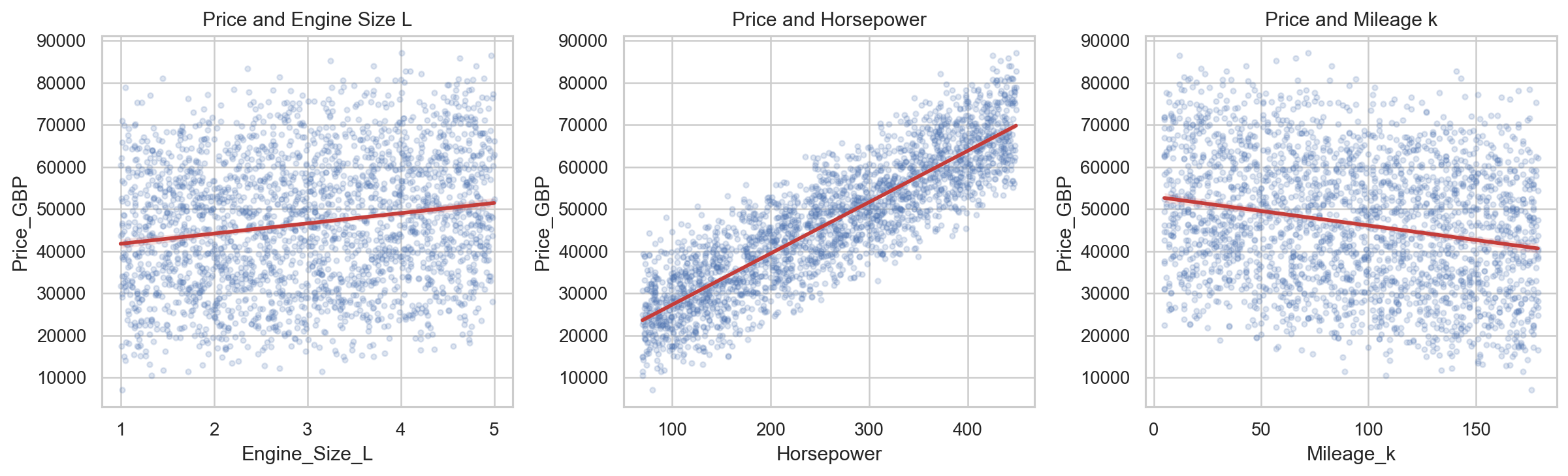
The study generates 10,000 synthetic car records using a fixed random seed. Exploratory analysis looks at engine size, horsepower, mileage, fuel type, and brand before modelling.
Synthetic data, with reproducible assumptions. 02 / Reserve the test set
Keep evaluation data separate.
A reproducible 70/30 split sets aside test records before model selection. Cross-validation uses only the training portion, keeping the final test set outside the tuning process.
Seven parts for training. Three for testing. 03 / Preprocess and fit
Build one repeatable pipeline.
Numerical features are standardised and categories are one-hot encoded. A scikit-learn pipeline fits a linear regression model; five-fold cross-validation compares parameter settings on training data.
Preprocessing stays inside the modelling pipeline. 04 / Inspect the errors
Look beyond a single score.
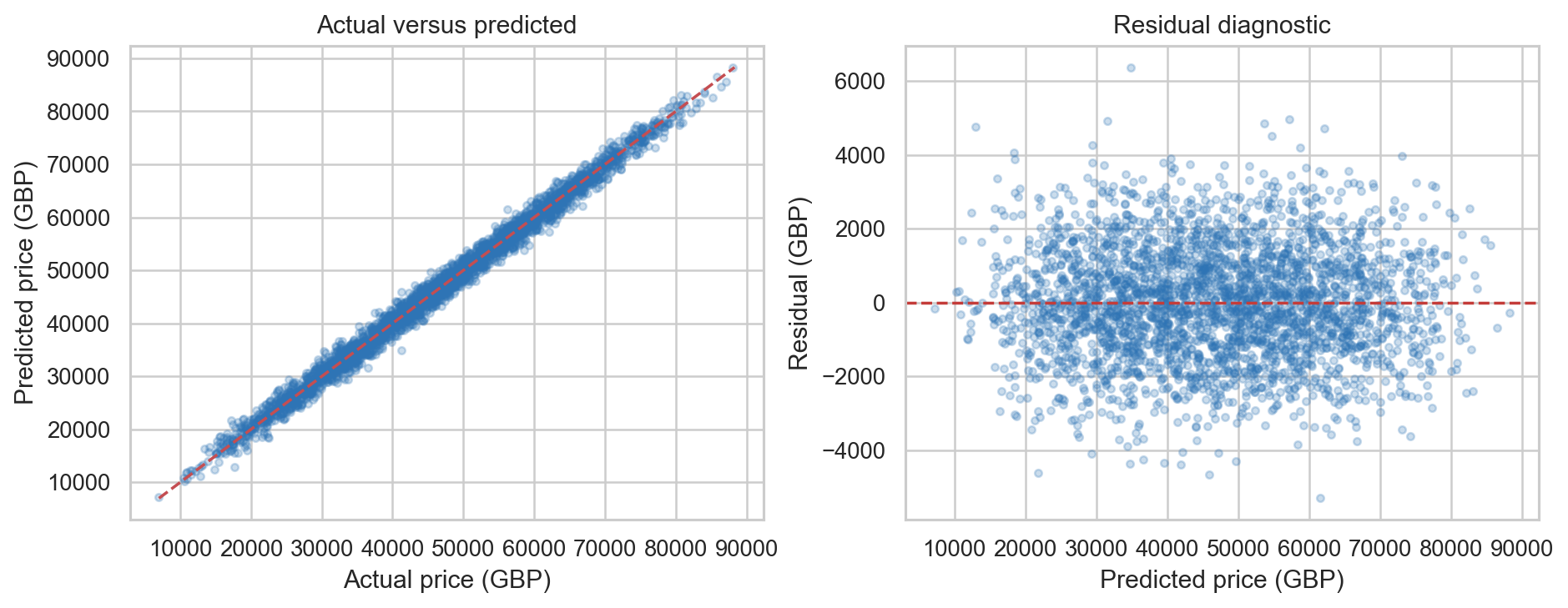
Saved notebook outputs report test RMSE £1,490.78 and R² 0.9907. Predicted-value and residual plots help inspect errors. The tuned model matches the baseline, and synthetic-data results do not establish accuracy on real listings.
Evaluate the result within its limits.